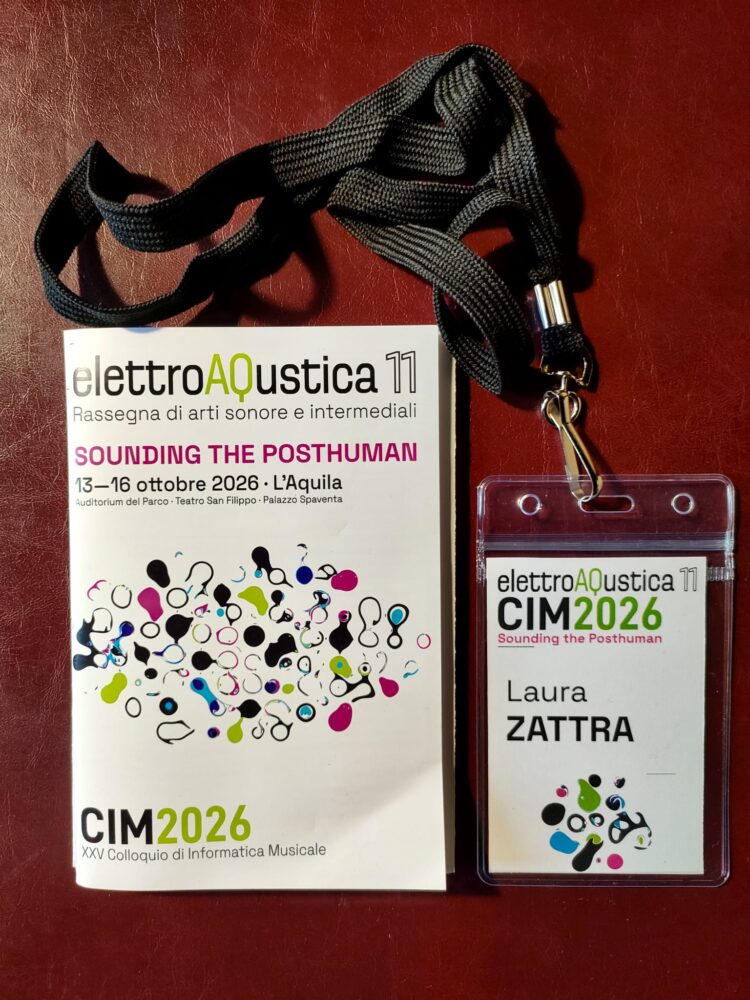
CIM Conference Programme

Sounding Posthuman: Reflecting on 50 Years of CIM and a New Perspective on Teresa Rampazzi

What an inspiring week in L’Aquila!

I am so happy to have been part of CIM (Colloquio di Informatica Musicale), which 10 days ago (October 13–16, 2026) celebrated a major milestone: its 50th anniversary! This year’s inspiring theme, Sounding Posthuman, provided the perfect framework to introduce a new direction in my long-standing research on Teresa Rampazzi.

It was an honor to present my paper, “Writing Teresa Rampazzi. Between Historiography (1998–2026) and Post-Human Rereading”, as well as to chair a session and moderate the roundtable for our MEDEG (Musica Elettronica Donne e Genere) group.

Beyond the Bourgeois Instrument: The Posthuman Pioneer

My presentation brought together nearly three decades of archival research, source criticism, and oral history (from 1998 to 2026) to re-evaluate Rampazzi’s artistic trajectory through the lens of posthumanist theory (drawing on Rosi Braidotti and Donna Haraway).

When Rampazzi abandoned the piano at age fifty—the quintessential anthropocentric device of Western bourgeois humanism—she turned to analog generators, magnetic tape, and eventually computer systems like the Interactive Computer Music System (ICMS). By doing so, she dismantled the myth of the solitary romantic genius. Instead, she embraced a collective, distributed, and cyborg creativity within the Nuove Proposte Sonore (NPS) group and her collaborations with scientists and engineers at the University of Padua’s Centro di Sonologia Computazionale (CSC). Long before posthumanism was formally theorized in philosophy, Rampazzi’s practice anticipated the decentralization of the human subject, treating technology not as a mere tool, but as a cognitive prosthesis and a co-creative partner.

Thank You & Open Access

Thank you to everyone who made this anniversary edition possible and to such a vibrant, passionate community of researchers, artists, and musicians.

All conference papers (including mine) are available for free download on the official program page:

CIM 2026 Program & Papers

Direct link to my paper: Scrivere Teresa Rampazzi. Tra Storiografia (1998-2026) e Rilettura Post-Umana
The NPS Group (first phase: 1965-1968). Teresa Rampazzi wears sunglasses.

Teresa Rampazzi in the last issue of Positionen n. 114 “Heroines of Sound”

I just uploaded the full text of my new article on this site!

Laura Zattra (2018), “Sie war ihrer Zeit voraus. Teresa Rampazzi, eine wichtige Komponistin elektronischer Musik in Italien”, Positionen. Texte zur Aktuellen Musik, n. 114 “Heroines of Sound”, pp. 9-11, ISSN: 0941-4711.

Enjoy the reading.

DOWNLOAD HERE

The NPS Group (first phase: 1965-1968). Teresa Rampazzi wears sunglasses.
Frances Morgan [http://www.multimadeira.com/project/frances-morgan/]

Pioneer Spirits: New media representations of women in electronic music history

“Pioneer Spirits: New media representations of women in electronic music history”. A great article by Frances Morgan in the current issue of Organised Sound, Vol. 22, Issue 2 (Alternative Histories of Electroacoustic Music) August 2017, pp. 238-249. Teresa Rampazzi is numbered amongst those composers previously “either ignored or thought to be marginal […]. Some media representations of the female electronic musician raise concerns for feminist scholars of electronic music history. Following the work of Tara Rodgers, Sally MacArthur and others, [Frances Morgan considers] some new media representations of electronic music’s female ‘pioneers’, situate them in relation to both feminist musicology and media studies, and propose readings from digital humanities that might be used to examine and critique them”.

You can read the complete abstract here.

Frances Morgan is Deputy Editor of The Wire, former editor of plan b magazine, writes the Soundings column for Sight & Sound and is a regular contributor to this publication and to Electric Sheep. A member of the Wire Soundsystem, she will DJ the very wide selection of exclusive material, past, present and future.

Frances Morgan [http://www.multimadeira.com/project/frances-morgan/]

Teresa Rampazzi biography: a new entry in the Italian Enciclopedia Treccani

The Dizionario Biografico degli Italiani of the Italian Enciclopedia Treccani (originally published: 1929), is dedicated to notable Italian people (composers, artists, politicians, historians, etc.) past and present. It has been an honour for me to contribute with an entry on Teresa Rampazzi.

http://www.treccani.it/enciclopedia/teresa-rampazzi_(Dizionario-Biografico)/

The article contains a biography of Teresa Rampazzi, updated with the latest developments of my research; a list of works and writings by Rampazzi; a brief description of the Rampazzi archives’; the lists of references.

...
Cover Image Source: http://www.treccani.it/biografico/ (2017)
teresa-studio

Teresa Rampazzi on women and music (Happy International Women’s Day 2017!)

Teresa Rampazzi on Women and Music.
She was not a feminist and she did not recriminate sexual differences in the artistic world. She once said: “just as there are many women who have a demanding profession, the same is true in music […]. Unwittingly I risked compromising my musical interests when I got married. But they were much too important for me” [Teresa Rampazzi in interview with Luisa Galanti: L. Galanti, L’altra metà del rigo. La donna e la composizione femminile oggi in Italia, Imola,Grafiche Galeati, 1983, p.66].
If someone asked her if there is a feminine way to make music, she answered: “absolutely not. There is neither male nor female music. There are pieces composed by men which seem to be composed by a woman and viceversa, if by ‘feminine’ you think of something sweet, elegant, delicate. But a woman can be as vigorous as a man, or even more!” (Ivi, p. 72).
Download Teresa’s bio here: L. Zattra, “Teresa Rampazzi, Pioneer of Italian Electronic Music” (2003).
teresa-studio
Teresa Rampazzi in her studio in Bassano del Grappa, early ’90s (photo by Gianni Di Capua).

New content: writings on Rampazzi’s music

And finally you can read here (in this new page: https://www.teresarampazzi.it/writings-on-t-rampazzi/) a list of articles, books, and other material dedicated to Teresa Rampazzi.

I contributed with many writings to this emerging literature, since my Master thesis in 2000, and I’m proud of this.  The first articles dedicated to her dates back to 1979, with an interview Teresa Rampazzi gave to M. Mollia.

Many of these items are available online. Enjoy the reading!

Writings on T.Rampazzi