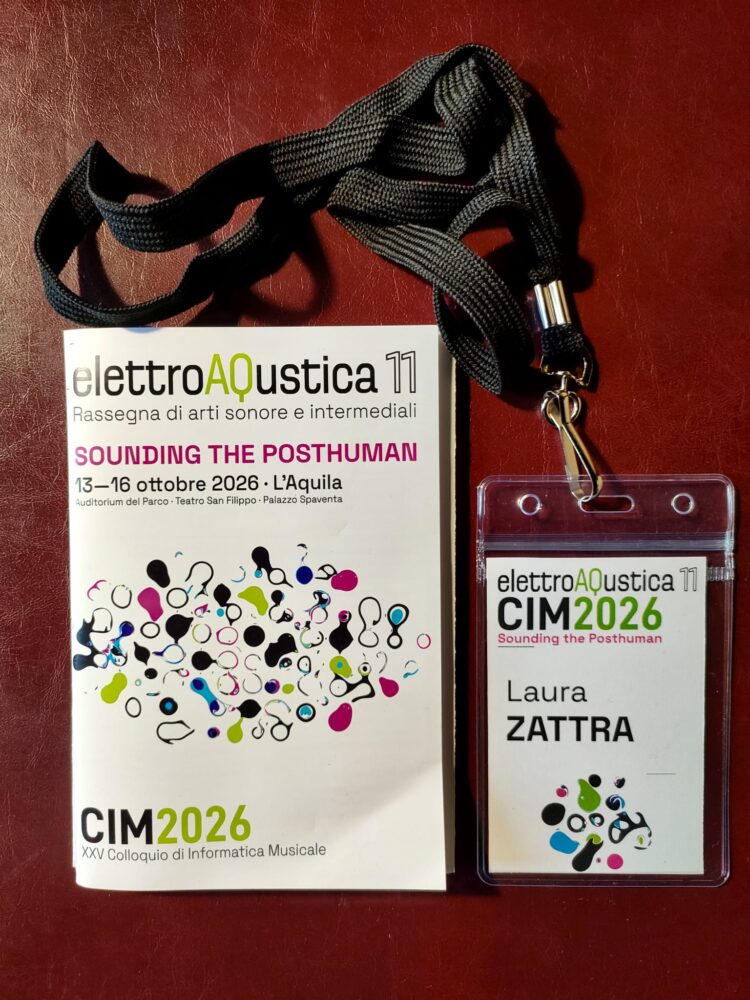
CIM Conference Programme

Sounding Posthuman: Reflecting on 50 Years of CIM and a New Perspective on Teresa Rampazzi

What an inspiring week in L’Aquila!

I am so happy to have been part of CIM (Colloquio di Informatica Musicale), which 10 days ago (October 13–16, 2026) celebrated a major milestone: its 50th anniversary! This year’s inspiring theme, Sounding Posthuman, provided the perfect framework to introduce a new direction in my long-standing research on Teresa Rampazzi.

It was an honor to present my paper, “Writing Teresa Rampazzi. Between Historiography (1998–2026) and Post-Human Rereading”, as well as to chair a session and moderate the roundtable for our MEDEG (Musica Elettronica Donne e Genere) group.

Beyond the Bourgeois Instrument: The Posthuman Pioneer

My presentation brought together nearly three decades of archival research, source criticism, and oral history (from 1998 to 2026) to re-evaluate Rampazzi’s artistic trajectory through the lens of posthumanist theory (drawing on Rosi Braidotti and Donna Haraway).

When Rampazzi abandoned the piano at age fifty—the quintessential anthropocentric device of Western bourgeois humanism—she turned to analog generators, magnetic tape, and eventually computer systems like the Interactive Computer Music System (ICMS). By doing so, she dismantled the myth of the solitary romantic genius. Instead, she embraced a collective, distributed, and cyborg creativity within the Nuove Proposte Sonore (NPS) group and her collaborations with scientists and engineers at the University of Padua’s Centro di Sonologia Computazionale (CSC). Long before posthumanism was formally theorized in philosophy, Rampazzi’s practice anticipated the decentralization of the human subject, treating technology not as a mere tool, but as a cognitive prosthesis and a co-creative partner.

Thank You & Open Access

Thank you to everyone who made this anniversary edition possible and to such a vibrant, passionate community of researchers, artists, and musicians.

All conference papers (including mine) are available for free download on the official program page:

CIM 2026 Program & Papers

Direct link to my paper: Scrivere Teresa Rampazzi. Tra Storiografia (1998-2026) e Rilettura Post-Umana
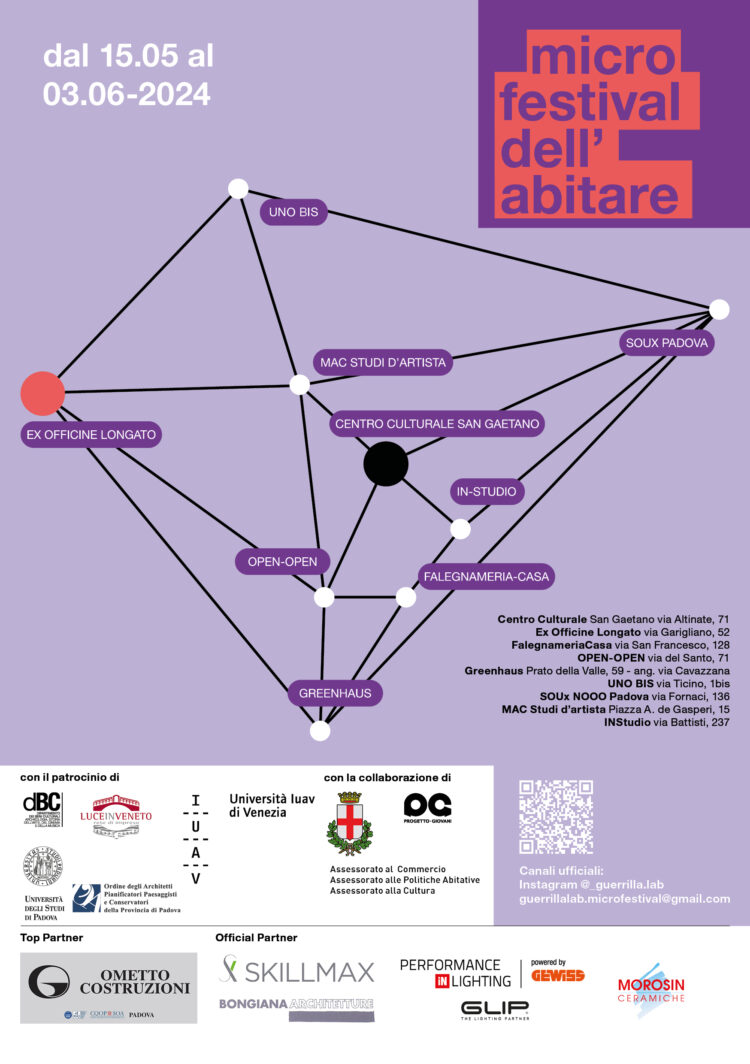
MIC_24_flyer_def_blueprint_e240425

Teresa Rampazzi: sound creations and co-creations as a meeting place between art and life

Laura Zattra will discuss in PADOVA with Marta Previti and Maddalena Rizzi of women who, starting from Padua, have left a strong artistic mark in Veneto, Italy and the world.

Laura will address how Teresa Rampazzi revisited the idea of creative place, from the home, to the collective, to the conservatory, to the university, in her talk “Teresa Rampazzi: sound creations and co-creations as a meeting place between art and life.”

MICROFESTIVAL DELL’ABITARE_GUERRILLAB MATSURI #02
MEMORIA e RIUSO dal 15.05 al 03.06 2024

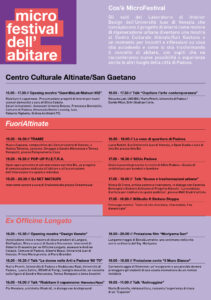
Complete program here.

The Microfestival second edition builds on the outcomes of the Interior Design Workshop held by Silvia Codato with the collaboration of Davide Cecconello and Elisabetta Gabrielli in the second year of the Bachelor of Product Design, Visual Communication and Interiors at IUAV University of Venice.

MIC_24_flyer_def_blueprint_e240425 MIC_24_flyer_def_blueprint_e2404252

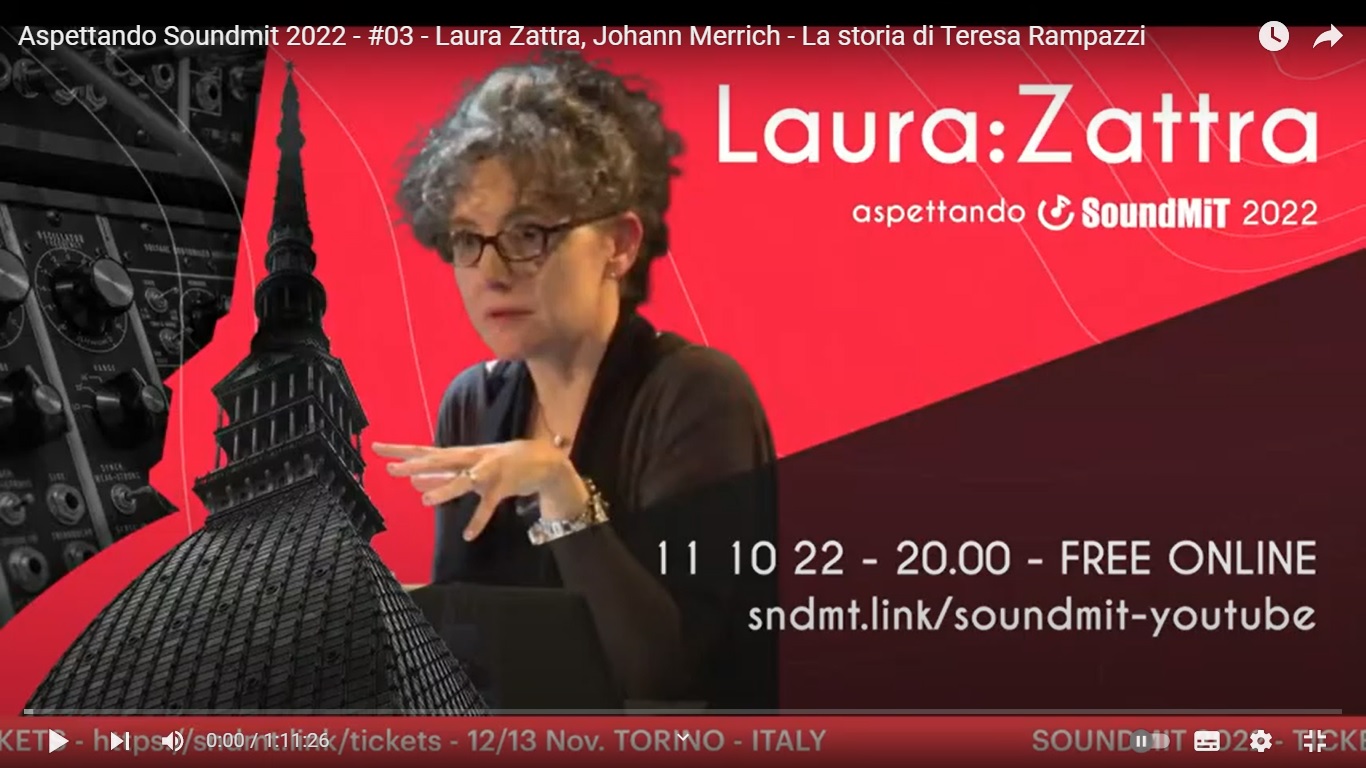
Laura Zattra talks about Teresa Rampazzi at the SoundMit event

Il video dell’intervento di Laura Zattra dell’11 ottobre su Teresa Rampazzi è visibile al link seguente: https://www.youtube.com/watch?v=Sek8tl1hmSQ

Grazie a Johann Merrich e a SoundMit per l’invito.

Play


_collid=books_covers_0&isbn=9780262539302&type=

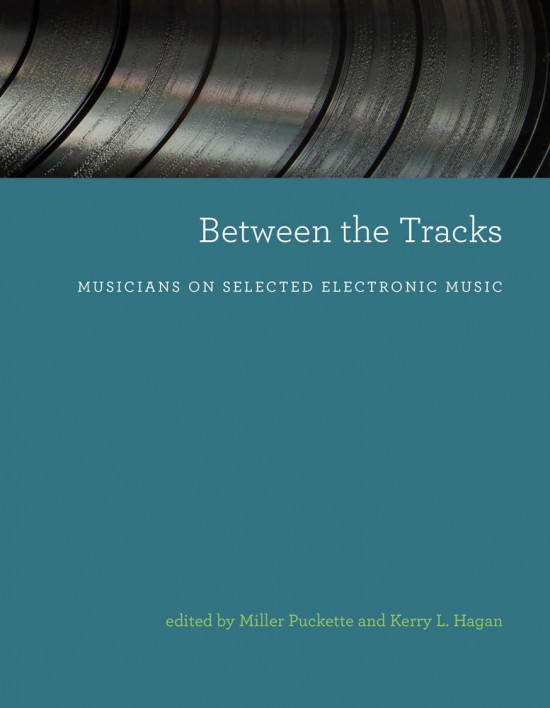
“Taras on three dimensions” in the new book Between the Tracks (2020)

The book Between the Tracks-Musicians on Selected Electronic Music edited by Kerry Hagan and Miller Puckette is finally published!

My chapter focuses on the analysis of “Taras su tre dimensioni” [Taras on three dimensions], a work realized by Teresa Rampazzi in 1971-72 in the course of a transitional phase (her transition from the analogue to the computer music technology).

The approximately eleven-minutes work represents an unicum among Teresa Rampazzi’s repertoire. It is made from the juxtaposition of three typologies of sounds: analogue, concrete and computer made sounds, and is also the only piece in her catalogue which incorporates concrete sounds.

To know a little more about this unique piece, read (and listen) from my prevous post): https://www.teresarampazzi.it/2019/07/02/teresa-presenting-her-unique-concreteelectroniccomputer-music-piece-taras/

_collid=books_covers_0&isbn=9780262539302&type= 117724413_10158138059855804_6304414956161648360_o

btr

The Junghans Watch

btr

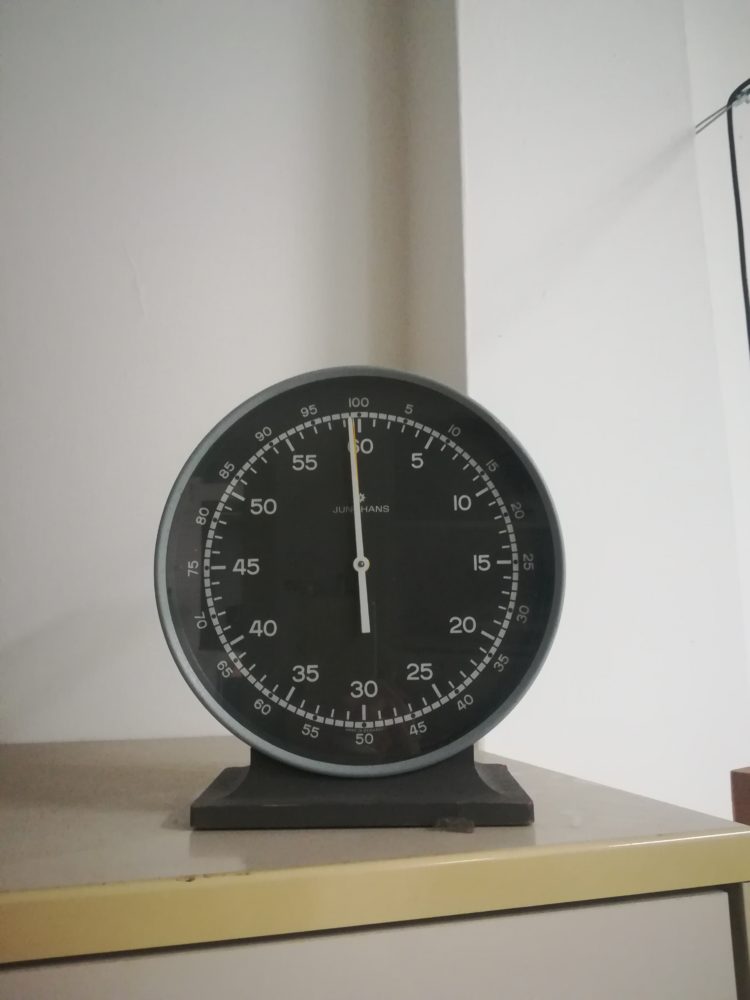
This is a picture I took last week at the CSC – Sound and Music Computing Group – UNIPD in Padova.

The Junghans Watch was the one owned by Teresa Rampazzi. She and her teammates at the N.P.S. used it to synchronize every manual operation they needed to create an analogue electronic music experiment, an ‘oggetto sonoro’ (‘sound object’).

The ‘oggetti sonori’ were reminiscent of Schaefferian “Traité des objets musicaux” (Rampazzi was at the GRM in Paris and she had a copy of the Traité autographed by the author), but they were intended to be an evolution, and in fact they were purely synthesised, not concrete.

Laura Zattra